

Today started very early – 6.15. We jumped out of bed and put the kettle and our clothes on and had coffee and went off down to the church. The preliminaries of the mass had begun and the statue of the virgin was in the church with a white veil. We all walked down towards the sea with it and met Magdalena who said she’d been up all night working on the curanto.
There were some little girls in white dresses and silver wings who stood up near the virgin in church. The service before the procession mainly consisted of murmured prayers. The church wasn’t very full beforehand but I couldn’t get Mungo to stay still so sat outside by the tree. Margharita Atan came by and as usual was loaded with little things for babies – bread, a wee cloth for wiping their hands and another for faces. She had the baby “Gringo” ( Roberto) with her. Mungo wandered off and the mothers warned me to get him back and not let him get near the dogs.
Just before the procession began Margharita rushed me into the church and we watched it assemble – all the children first and then the statue carried by various people, Salomon Teao and Magdalena amongst them. Then we all went down to the port singing and chanting behind the statue. It seemed really quite a long way. It was fairly solemn. Margharita kept me in order and made sure I was walking on unstoney bits of road.. The men and women seemed a bit separated but not as strictly as in church.
When we got down to the port most people went to the little shrine made of banana leaves but Margharita made me go up the slope to see better. I’d given my bag to a lady on a horse who I later discovered to be Isabel Teao. I was a bit startled to notice she had only stumps of fingers. Leprosy I presume. It was nice of her to take my bag on her horse.
There were a couple of people on horses. After the service we processed back and went into church again. There was a wedding of Nicholas Pakerati, 60 to a 20 year old Chilean girl in a wedding dress – very European and traditional except it was rose pink! The padre says she has a bad reputation.
When the wedding couple came out of the church the bridegroom flung handfuls of coins into the crowd for children to scramble for. They were newly minted 2 centissimo pieces. I noticed the mad old lady collecting them feverishly but otherwise only children did. Mungo got one or two given to him.
After this Margharita took me down to the port for the curanto. We (Grant and I) were guests of Magdalena and I discovered afterwards that this meant we had rather high status and were allowed into the special enclosure for the family where the earth oven was. But I didn’t realize this at first and allied myself to Margarita. But first I sat down with a little group including Isabel Teao and a Chilean woman with a black curly haired baby called Jorge (looks very female). The little baby was Isabel’s god son and obviously very attached to her, playing in her lap. Then I joined the French Unctad girl and was given some coffee by Magdalena and two pieces of bread. I scarcely had time to begin those when a little girl brought me a message that I was to join Margarita so I followed her to one of the portside houses and inside was Margarita, Eliana from next door and a few others having a precuranto feast of bread and fresh cheese and cake with coffee. We were given some too but Mungo knocked his over.
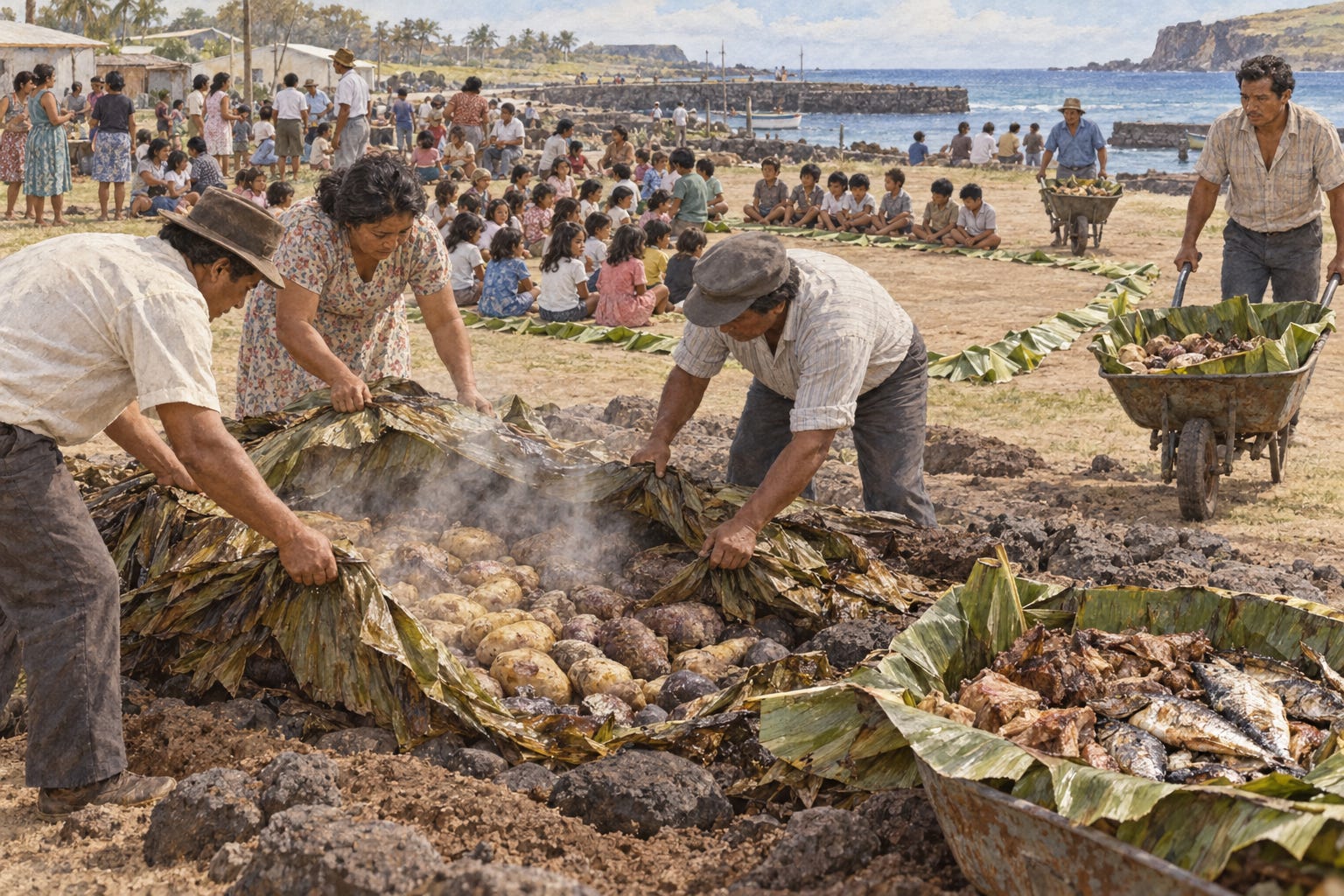
Then we went to watch the oven being opened. First came out heaps of potatoes and tarot and then meat and fish which were distributed in the enclosure and outside in wheelbarrows. The children all sat in rows in a square marked out by banana leaves. Otherwise there were family groups scattered about. I only found out afterwards that there wasn’t enough food to go round and one side of the square never got any.
I was rather torn between being with Grant in the special enclosure or going to the Margarita group. Finally I explained to M that I’d been invited to eat with the padre which seemed to be quite acceptable.
The padre blessed the food to begin with and then we were given chunks of food. Really beautiful meat as usual, pork too,- and sweet potato and bananas.
After eating I wandered about talking to people. Mamaflora, I said hallo to. Also a woman who had heard we were looking for a house. I talked a bit to Blanca Pont who lost her husband a few months back. She has a son in Tahiti and a daughter in Santiago studying and three more daughters here. Mungo got kicked once but enormously enjoyed the whole atmosphere and ate a lot. I enjoyed it too. There were so many people we knew and wanted to talk to us. Maria’s tourists were there having tinned peas with their meat!
One of the paradoxes of island life was the way processed or tinned food was prized above fresh local fare. I remember once, actually in pineapple season, someone trading a shell necklace for a tin of pineapple proffered by a sailor off one of the rare ships that was visiting. Certainly tinned peas would have been special.
As usual everyone just drifted off afterwards. We were amongst the last to go and stayed talking to Magdalena’s little group. She was eating sugar and lemons in the end.
Isabel’s husband is a carver and I think he might have had leprosy too. He wanted to see my hairslide to copy it.
When we got home we started packing up. Carlos is letting us borrow some furniture. He was fiddling with his loudspeakers this afternoon.
29 May, 2026
There is not a lot of detail on the house which became our home on the island for over a year. Unlike Piriti it was in the heart of the village just across from the church and had various close neighbours including the mother and father of Georgina and all her siblings.
It was an old wooden house made up of one room which we divided into two with a curtain thus making a bedroom and a living room for ourselves. I remember sometimes lying in bed behind the curtain listening to the murmur of Spanish as Grant interviewed people way into the night.
Outside was our kitchen with a tap and a sink. We had a smoky old paraffin stove to begin with but graduated to an electric hotplate which used to give me tiny electric shocks when I fried eggs. There was also a “bodega” or store room where we kept food stores like sacks of flour and rice. There was no bathroom but we were told we could enter the toilet and shower next door through an outside entrance.
The front door led out on to a concrete patio which was raised about four feet from the path below and it was there I did the washing in my oil drum and chatted to passers by.
Simple though it was, I loved this little house because it was ours. It was also brilliantly located for the work - opposite the church and the padre’s house. People would call on us and talk about all sorts of things as well as ask about genealogical matters on which Grant was fast becoming an expert.
After settling in and giving Mungo a rest we set out to buy things for the house, carefully locking up first. We went to Romero’s first and stayed a long time.
Romero was a continental Chilean who had run a little shop on the island for a long time.
It was all rather interesting. First we has jugos [reconstituted powdered fruit drink] out on the porch – very stagnant tasting! Mungo romped with the dogs and admired the duck with its eleven ducklings and we explained what we wanted for the house. He very sweetly lent us two cups and saucers, two plates, a saucepan, two bowls, two glasses and an aluminium cup. We bought a few other things but he had very little for sale. He did have light bulbs though – and chocolate, which was nice.
After we’d had the jugos he offered us tea and we sat down with him – inside this time – and had the tea. There were animals everywhere – the big dogs, the duck and ducklings, and about three cats huddled up to the electric burner which sits on the counter of his shop. I decided that the shelves of his shop were more a personal store than a display of things for sale. When we asked for cream [tinned] he said he had none when it was plainly visible amongst all the junk.
He’s a remarkable looking old man with silver hair and a silver moustache. He was very welcoming and said that the solitude was awful sometimes and he lived with the animals alone and, though the people here weren’t bad, he had terrible problems with people thieving and buying things on credit. He likes Mungo and was quite happy to let him play with an old toy motorcycle left by the Americans – hopefully “for sale.”
His merchandise is extraordinary – a fairly orthodox corner of statues and fruits – a candelabra with electric light bulbs, not all there – lots of ancient Chilean books and magazines on a table and in the centre a little stove for brewing coffee and tea.
He gave us some little jars and a pineapple. He loves animals, he said and is a bit of a botanist. He has a book and says there are lots of plants on the island that are good for illnesses. He sold us some aspirin for colds and kokongo [flu] with a witch doctorish air and then took us out to look at a plant that was good for stomach trouble. When we went in again Alvarez [another Chilean shopkeeper] was drinking coffee at the table a bit sulkily.
After we left Romero’s feeling very warm towards him we went over to Alvarez and bought a few more things and had a chat. He says his place is known as Alvarez Brothers because of the other one on the continent. They are swopping soon. He says he can find us a cheap apartment when we are in Santiago. I was struck by the loneliness of both Alvarez and Romero today. I felt for the first time that this was a real outpost of commerce. Doing business on Easter Island is a strange outcome for a trader.
We came back after Alvarez via the botelleria [bottle shop] which sold us two bottles of Rose at 45 escudos each. We tried to buy blankets at Orlando Paoa’s but he wasn’t there.
When we got home (to our new place) I got supper going and various kids looked in as did Maria, daughter from next door. She brought back the kitten.
I got very sooty cooking supper of rice, a packet of tomato soup and salami sausage.
Old Papiano Paoa Chavez popped in tonight and stayed to supper and told Grant a lot about Tahiti. I got very sleepy with the wine and the strain of Mungo. It’s funny – I feel it’s almost cruel to make him sleep on his own now. In England it would have seemed almost the reverse.
I find the lavatory a totally embarrassing experience – almost like going in public. One is quite audible and the possibility of being intruded upon completely inhibits me. I wonder if I shall ever get used to it.
In the end we gave up on using it because the door would constantly be left bolted from inside. We’d use the thick guava bushes outside and wash ourselves at the tap in the kitchen. Nobody said anything but when we returned later from our stay on the conti a toilet had been attached to our house!
It’s nice here though. We just had a cup of warm Milo which drives out the chill of the evening a bit.
I understate the love I had for that little house. Grant and I got on so much better when we were on our own.
Later on I wrote
The end of a busy day. We moved house – as usual rather harrowing but well worth it – we’re installed now and I feel a bit dignified again with a house of my own. It has its drawbacks – a lavatory without a door which reminds me of a Greek youth hostel – a stove if anything a bit sootier than Carlos’s – but the place is central and independent – what a joy that is.
This morning before we left Carlos made sopaipillas and after breakfast I went down to the ECA to buy food for the new house. I learnt a new Cat’s Cradle.
Daniel Tepano dropped me off at the house which had been cleaned and unlocked for us. I came in and waited ages for Grant who came in Mana Ika’s lorry. Victoria Atan, who lives next door, gave me pancakes and very sweet coffee which Mungo had. Her daughter lives here and so does baby Maeva, daughter of Pedro Riroroco of the Juzgado and the girl who looks after the library at the school.
The baby is six months old and very nice. Beautifully dressed – this morning in a blue babygrow and tonight in Mungo’s old angel top and tights. I noticed a row of white muslin nappies on the line today. She has no teeth but little gold earrings. She smiled happily at me At one point she was put in an armchair facing the wall thus forming a sort of corrale. Seemed very secure and quite willing to be held by me.
When Grant arrived we brought in all the stuff and I organized the kitchen. It has the same wood disease as the padre’s house and the biggest job was getting rid of all the powder produced by the termites. The kitchen was built by Carlos, he says. People are impressed by our few words of Pascuence because as they say Rosa spent two years in a Pascuence household and didn’t learn a word.
Afterthoughts
I realise doing these diaries takes its toll. Grant has been dead over three years now and I know I’m perfectly OK being solo. In the beginning, however he would often occur in my dreams, but always absent - somewhere else.
Last night, though, he was sitting in a corner with his head in his hands and when he looked up I could see he had been crying. I wonder if the diaries upset him or its just sadness at not being alive any more. They say you shouldn’t speak ill of the dead but when I wrote the diaries he wasn’t dead at all. Indeed when alive he did say leave nothing out. “It was what it was”. And because of that I think for both of us I have to go on.