

Because Grant was a traditional anthropologist he wanted us to arrive at our field site as naive and unknown people which meant no arrangements in advance. We’d just see what happened. Actually there was no internet in those days and tourists staying for a week or two mostly relied on people who rented out rooms in their houses.
Looking back I can remember us surrounded by our luggage and many tourist hunters approaching us but on hearing we were staying for upwards of a year and couldn’t pay nightly rates shaking their heads and going away. Finally we were almost alone when a truck stopped near us and we were hailed by an exuberant and flamboyantly dressed tourist seeker who, it turned out, was eager to rent us part of her house and could even get a cot for the baby. Her name was Georgina Riroroco Tuki and from then on she and her family adopted us. We hopped on the back of the truck with our stuff and drove to a house named Piriti, which had been a night club during the years that a US Base had been situated on the island. The base had departed hastily when the socialist Allende government was elected in Chile leaving a generator, some ancient bottles of salad dressing and quite a few babies behind.
But now, over to the diary to hear first hand about the place and our landlady and how we got on.
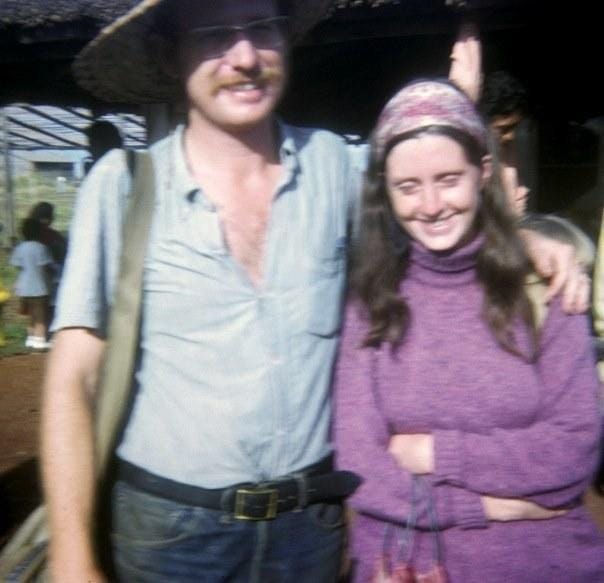
Julia and Grant on Rapanui, 1972.
We are now settled in a house near the airport owned by a Chilean Carlos Mardones, and his wife Georgina. Actually the house belonged to the Riroroco family of whom Georgina, his wife was one). We have a smallish room of our own with a cot for Mungo and are paying 400 escudos a week (17 dollars). We knocked this down from 800 which Grant had inadvertently offered. There are three children in the household – all a bit grubby but very affectionate and nice – a girl of 6 who is only here at weekends, called Georgina after her mother, a boy Carlo, after his father and a little boy called Christian. The house is built of wood and corrugated iron and is full of unexpected electronic equipment, left I suspect by the American airbase.
There was a secret US airbase located on the island in the 1960s. It packed up and left when socialist president Allende was elected. About 100-150 military personnel were stationed there and the place had a PX, a shop full of nice things. Some islanders were employed by the base in different capacities. The base also left its generator which provided 24 hour electricity while we were there.
There are two radios, two record players, two fridges and a blender. At least one of the first works too. The living room has a rather good lino tile floor but the dining room is stone (cement) and so is the kitchen. Our bedroom has a cement floor. The living room has a picture of a nude girl on the wall along with some shell necklaces looped about and a few odd photos. There are two little heads – American or Chilean I think, having a telephone conversation. The whole effect is a bit pathetic. They have a very old but serviceable lounge suite too.
The house, we learnt, had been a night club largely servicing the American Base which was nearby. It had been christened “Piriti” (Pretty) by a patron. On the wall was a framed collage of headshots of the Americans who came to Piriti.
I learnt two cat’s cradles tonight from Elena, a neighbour. Mungo is yelling fit to burst his lungs.
One of my missions was to collect Cats Cradles (string figures) and I asked about them when I could.
We are off to mass in a minute.