

Monday April 10, 1972
I went to the ECA this morning after calling in at Lan Chile with Grant to find what had become of the box. (A piece of our luggage which got lost en route) The LAN office is a grubby little place on the FAC base near the runway.
After the Lan office I went to the cooperativa and bought six eggs and six little peppers. Then I was given a lift home and was accosted by a terrible American woman who is touring here at the moment. After that I left Soledad (the girl’s name I now discover who works here and I suspect of being Georgina’s eldest daughter) and went to the ECA which wasn’t too full. I was helped by a really nice sensible woman called Maria Ihe (as far as I could hear). She was nice and clear about showing me how to make my list and get a bill and then get the goods on the bill. I bought a small Nescafe, 2 toilet rolls, 10 jugos and one kilo of rice. After that I felt rather confident and went to Alvarez, the little shop on the corner and bought a bottle of vinegar for 30 escudos which seemed a lot.
Then Mungo and I went to the funny little junk shop with ducks and kittens at the back and we shared a jugos and I bought a tin of tomatoes.. It was a very peaceful ten minutes I spent there with my juice on the veranda waving to people who passed on horses.
The old man who runs the place has a silver moustache. It stocks very little – a few sweet potatoes, tinned tomatoes and one or two other tins and lots of shell necklaces, carvings and coral.
When I got home a chicken stew was under way made with a home grown chicken. I deduced this from all the feathers round the dustbin. It was a tough but tasty stew. I talked to Sole a bit and she told me the plot of a John Wayne film she’d seen the night before, only totally non comprehensibly. I couldn’t understand a thing. She also expressed her contempt for Chileans. For all that she’s called her baby after his Chilean father. She also told me that there is a Well Baby Clinic here and she’s going tomorrow. Tonight, to my surprise she’s going to an evening class. For senoras, she said. Something that sounded like Liberal Arts.
Mungo and I fell asleep after lunch as did Christian, and woke in stuffy rooms around 3pm feeling terrible. Christian moped in the back yard for about half an hour and then Mungo and I set off for Maria’s.. She wasn’t there so I walked to the shore and watched 11 little boys playing football on the green(?). I fielded the ball for them once or twice. We played among the rocks for a bit and then set off for home and found Maria doing the washing by the wall on the way home. She invited me in and gave me jugos and I gave her the little angel top I’d set aside. She told me that you can get free baby milk at the hospital. She’s a nice woman. She gave me some coral and sausage and two tomatoes.
I grew to understand and appreciate the gifting that was part of all visits and learnt to do it myself after a bit.
When I got home I made Mungo some scrambled eggs and the old man who gave us a bunch of bananas some days ago came by with another and a reproachful look.
I’d not been reciprocal I guess.
I got him coffee and fed Mungo and finally Grant came home and gave him some razor blades which he wanted. He’s giving Grant his genealogy now I think.
I’m tackling Rapanui language now I think. I don’t think I’ll get anywhere unless I do. Today I felt a bit inadequate and as if I was doing nothing – no baby studying or string figure collecting. I must try harder.
Tuesday 11 April 1972
We got up at 6am today because Grant was meeting Sergio Rapu at 7.30 at the school.
Sergio spoke perfect English, having spent many childhood years in the US with the family of Bill and Emily Mulloy. Bill was the principal architect on the island and had restored a lot of statues. He was a schoolteacher the but went on to be Governor of the Island in Chilean dictator, Pinochet’s time
I walked down with him. The town was very much alive with children going to school and trucks setting off for outside town. We met Sergio in his van and he took us to school. I went down to the fishmarket but as usual there were no fish. It was beautifully cool and I got a lift from the boyfriend of he girl next door who is going to dance in Santiago on Saturday. I did the washing when I got home and wrote to Pat. I had a moment of panic when I couldn’t remember her address – just complete blankness. It came back – at least I think it’s right.
I studied Rapanui for a while and at last a bit is beginning to stick. I can say the odd thing that makes sense to an Easter Islander. Sole and I went to the meat ECA and she bought two chickens and me one. We ate one of the chickens for lunch with noodles.
After lunch Sole said she was going to have her photo taken at the police station for her Chilean boyfriend (sweetie), one of the FACS officers who was here and would I like to come. So we trooped off to the carabinieri (police quarters) part of town at the end of the airport and went to visit a lovely little house full of strange things – dried fishes and a turtle shell – a tame pigeon and three little grey cats and a duck and two sorts of hens. We sat about for a while and looked at some photos of the woman’s family and then Sole took Mungo and had her photo taken with him and a big red flower. It cost, I think 25 escudos. The woman said she took all sorts of photographs. including passport photographs.
Many continental Chilean wives provided special services to the island, such as cake making, dressmaking and photography.
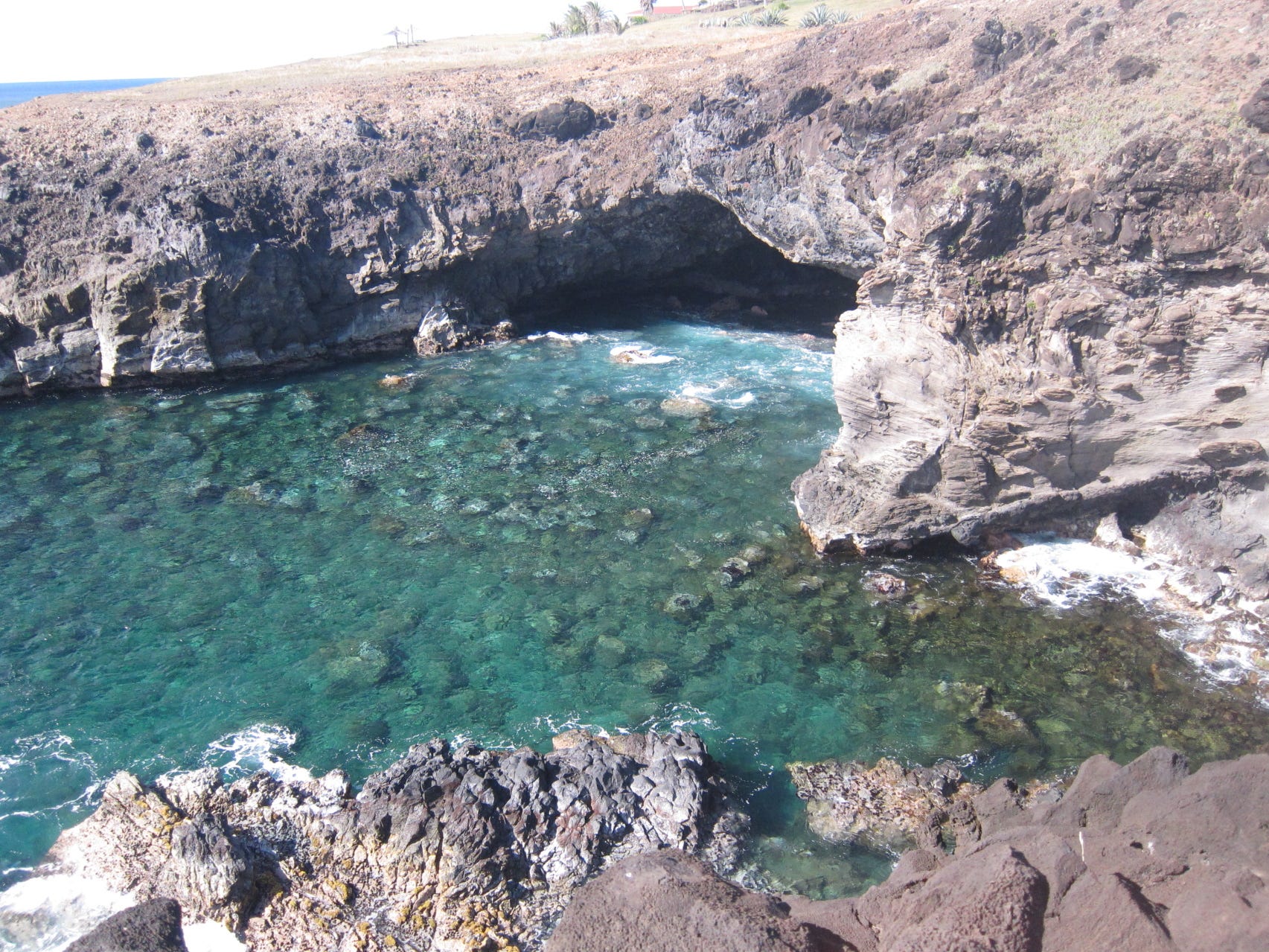
After the photography session we went to look for eggs in the cave Ana Kai Tangata down by the sea.. I was a bit terrified handing Mungo down over the volcanic rocks and I didn’t get right inside where there were baby birds but sat up on a rock watching ferocious spray bashing on the other side of my rock and seeing Sole paddling about down in the cave. I wondered if she ever felt trapped with the waves sealing her in every few minutes. She said it was very hot in there when she came back. She is very agile.
When we got home Carlo was a bit fed up because Victor (Sole’s baby) had been crying. Little Victor does get abandoned rather a lot.
It was a good day. I got the washing done too and darned Grant’s socks. Noticed that Sole doesn’t sterilize her bottles at all. I wonder if the clinic advises sterilization or not. What advice does it give?
One rather ghastly thing I heard today was that there are still five cases of leprosy living in the leprosarium. The youngest, who is only 24 has just lost a leg. It seems terrible that they should be out there on their own with two visits a week from the nurse except in cases of illness. They cook for themselves. What an awful sentence that must be. The doctor told Grant about it.
Leprosy, or Hansen’s disease probably arrived on the island in the late 19th century and many families lost large numbers of members to the illness. As with tuberculosis, malnutrition may have been a factor as the families least affected had access to meat from the sheep ranch whilst others did not. The sheep were raised for wool and tallow and surplus meat was apparently disposed of in the sea lest the incentive to work be eroded.
Chile annexed the island in 1888 and, in time, a policy was implemented (as in other Polynesian countries) of isolating sufferers in a colony on the outside of town. This place was called the sanatorium when we were there. Effective treatment in the 1950s and 1960s allowed people to slowly return to Hangaroa and live in the community. About four people still lived in the sanatorium out of town which had once accommodated and isolated many sufferers. I have heard that the sanatorium has since been closed and a memorial for those who died there has been created.
I was mistaken in imagining living in the sanatorium as a “sentence’ In fact I later got into the habit of visiting the sanatorium because it was a lovely place with orange trees unaffected by the pests that had ruined the trees in town. The people there seemed content and happy to have the odd visitor.
A few people in the village still bore signs of having had the disease. This did not seem to be a stigma, although Continental school children (those belonging to government officials stationed on the island) still used to mock islander schoolchildren by mimicking having no fingers and suchlike. It played its part in the complex tensions between islander and continental Chileans at the time, as will emerge in the diary later on.