

Carlos has taken off for Santiago and Coca has arrived at the house plus her elder brother Victor Sylvester (Sictor) and Graciela, daughter of Maria/Suzy.. I don’t know if [Coca] was informed about her father’s departure or not. One thing – although Georgina doesn’t own the boy as far as we are concerned, he knows who his mother is.
All the kids swarmed in and started gobbling bread. I’m trying to get them to ask before taking things – I don’t know quite why but I feel it gives a sense of order of which there is little enough here. This morning Carlos told the children he was “Going to find mama”
Luisa Pakerati and a son left for Santiago this morning – so did Melchior. We gave collares for the first time. (giving shell necklaces to friends leaving the island was customary)
7.30pm
Just returned from my Emglish/Pascuence lesson at Maria Tepano’s. Her real name is Maria Teau Fati. There was a New Zealand girl there today who put a bit of a strain on the situation, nice though she was. I felt reluctant to discuss the needs and wants of the island in front of the Tepanos, which she wanted to do. My lesson wasn’t as good as last time because of the distractions.
The Tepanos refused to be godparents to Rosa and Luis’s baby because they had too many commitments they said.
When I was learning Pascuence Maria picked up a postcard of a Tahitian girl with bare breasts and immediately taught me the word for breast without embarrassment - interesting that Helen Reid noted that women were very shy about their breasts. Very unPolynesian. Certainly once at the airport I noticed elaborate covers around breastfeeding women – but also I’ve seen one or two women feeding babies without this – at Soledad’s aunt’s for one
Rosa took over today and it’s not been too bad. I washed up but let her cook. She’s a bit less withdrawn now and asked me if I wanted more babies today.
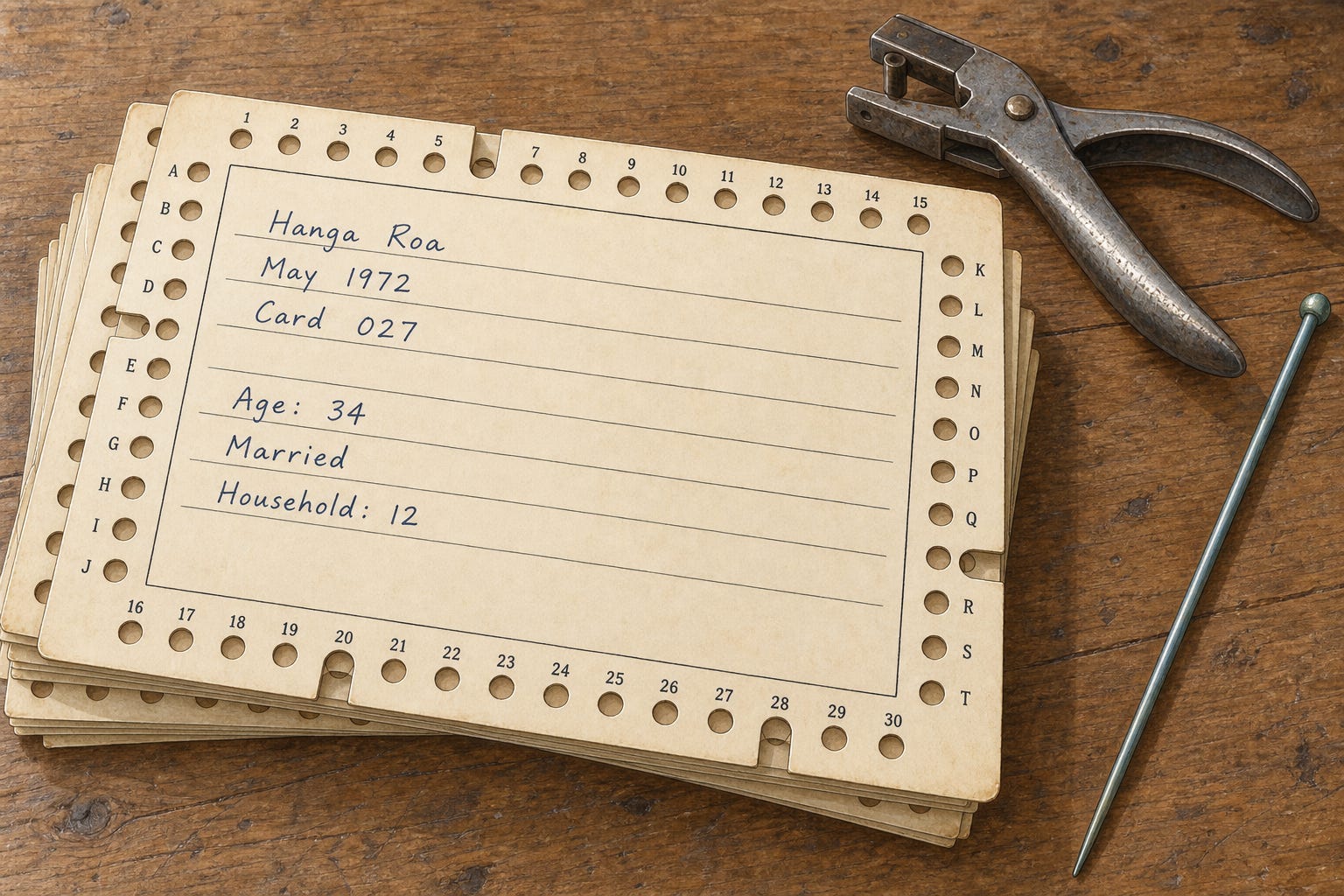
I’ve been stamping Grant’s census cards and putting them in order for him. It takes hours with a hole punch.
Grant had this primitive but effective way of sorting data about people - male female married single and other categories. Each person had a card with little circles round the edge. Each circle was a characteristic and could be punched out. Then a knitting needle could be slid through the holes and all the men would emerge, or all the old people etc. It seemed very cunning at the time.
Sunday May 7th continued
We left at 7.30 am to go to mass. I met Maria Tepano (my student) and her guest at mass. The girl insisted on saying “beautiful” in my ear at the singing. Mungo wiggled and wanted to play. The mass was very full today and the singing a bit orthodox and melancholy. I sat under a statue.
After mass I talked to Maria Atan – an old lady, the wife of the round faced old man who speaks a bit of English. He was wearing a hat with a pink scarf tied around it – looked very dashing. I said Hallo to the widow I met at the funeral and How are you. She answered “Riva raki” [So so]. She’s the mother of the little girl with the plait who hangs around with that slightly crazy Alicia. She has five children.
After talking with the old man from the co-op who wears a beret (Jose Fati, a very good informant of Grant’s) we made our way to Valeria Paoa’s with the help of the fuzzy haired tubby woman called Margarita Atamu.
Margarita and her husband Petero became good friends of ours, partly because they were fostering a half American baby Roberto, who was the same age as Mungo. They played together and we sometimes went out on horses with the boys to the campo. Margarita and Petero had no children of their own. She’d been the cook at the sanatorium before almost everyone came back into town.
Margarita was a tiny woman who took on the role of mother substitute for me and was full of advice especially on hygiene. “The important parts to wash are here and here” On one occasion she took me aside before mass and authoratively ordered someone to get water and a cloth and scrubbed the dust off my legs. She was always bringing us sopaipillas (a sort of fried flatbread) and I reciprocated when I could. I loved Margarita, I think because she made me feel safe.
She’s a relation of Valeria’s and is fostering a little one year old called Jim (renamed Roberto), whose American father took the mother to the States for six months (so the story goes) and sent her back to get her father’s permission because she was underage. Once she was back on the island the troops pulled out and apparently someone on the island wrote to him that she was playing around with other men on the island. He then took no notice of her any more and she finally gave the baby to Margharita and went to Santiago.
Margharita is very fond of the baby. She described how he was shy in public but at home ran about without a nappy. She said he ate soup. She also said there were two sorts of blood – strong blood and mas o menos (more or less) blood. If you have the former type you shouldn’t go out in the sun too much. She doesn’t like the sun. She said that the measles hit the teenagers hardest and it was only her nursing that saved one of them. Some people died in an epidemic.
We were given fried eggs for breakfast. Valeria (who was asleep when we arrived because she had been playing cards the night before) sat with us. Before lunch we sat about a lot. I went out to the kitchen at one point where there seemed to be a bit of life. Valeria’s mother (incredibly young looking) was threading a shell necklace. Little Anerica Riroroco was punching the holes in the shells though later the Chilean wife took over. The mother said it took half an hour to make a collare. Three children were sitting at the table. Valeria’s mother looks after a little boy called Alberto (5 years old) who she says is her grandson. Her mother is Chilean and doesn’t want him. He was born small ‘2 kilos or less’ and he talks less than the son of Valeria who is three. He seemed pretty thin and unfriendly but he played quite intelligently with a matchbox, pushing it along like a car. When Christian trod on the matchbox purposely he lashed out at him and chased him away pretty savagely.
After lunch we talked a bit and it emerged that Valeria's sister, Rufina was Miss Easter Island. She seems a bit joyless about the whole thing now but she got the photographs out. Apparently the thing was settled by vote. She had a chance to go to Australia but she didn’t go because she was in love with Sergio Rapu, according to her sister. I remember the matrona saying Rufina always looked sad because her family rejected her after she’d been 8 years on the continent. Most of the photographs showed her looking very strained and not very pretty. She’s the girl Sergio is supposed to marry.
Valeria gave me a funny baby garment for Mungo when he needed changing – also two Chilean nappies.
I felt the Paoas were very unrelaxed about us and was glad to leave around three o’clock.
We went to the house of the man at the hotel, Alberto Edmunds Paoa which was really very elegant with a beautiful kitchen. His mother and sister were there and gave us tea with cake and jam! And Mungo was given some milk. He [Alberto] was working this afternoon. His mother looks very unislandish with reddish hair and pale skin – she has French blood, she says. She loved Mungo and played with him and found him a little top to wear. He had a wash in hot water, for they have it there. There were lots of well established trees in the garden – a hibiscus and a tree with yellow flowers.
I’m trying to note what electrical gadgets and modern imports each house has. The Paoas – two record players and a fridge in the living room. A treddle sewing machine. The Edmunds Paoas – a double sink unit and a gas stove with an oven and an electric stove. A glass fronted cabinet. Both had plastic flowers. There’s no escaping them. I find the public areas of these smart houses a bit sad and lifeless. The kitchen of the Paoas seemed so much realer than the living room. Both households had upholstered chairs. Just before we left the head of FACH came in – a very slick character with glasses – rather attractive. He gave us a lift home. We went out again to visit Carlos Bruner but he was out. He has cigars for Grant.
I am quite startled to remember Grant liked cigars (but not cigarettes) in those days.
This evening we went to the town cinema and saw a film about the Harlem Globetrotters.
The ramshackle tin building was much more popular with the islanders that the FACH (the one run by the Chilean airforce) one, perhaps because it was in the heart of the village and a lot more rowdy!
It was packed so we had to stand. Costs 8 escudos. Lots of people I’ve never seen before. Lots of audience participation, from the kids mostly.